
Last updated: October 30, 2026
Quick Answer: For Buying and Delivery Decisions: The Complete Guide, the safest default is to choose the option that minimizes total landed cost and total delay, not just the lowest checkout price. In many cases, a small delivery upgrade can be worth it if the item is time-sensitive, fragile, or hard to replace.
Key Takeaways
- A buying and delivery decision weighs purchase channels, delivery speed, and receiving methods against total cost, timing, and risk.
- When the item matters or the schedule is fixed, certainty often matters more than price or speed.
- Compare shipping options by transit time, service level, handling, delivery windows, and the fallback if something goes wrong.
- Direct purchase often works best when support, packaging consistency, and returns matter most.
Buying and delivery decisions come down to one question: do you want the item now, with less uncertainty, or later, with more control over cost, timing, and risk? The right choice depends on what is being shipped, how fragile or time-sensitive it is, and how much delay the buyer can tolerate. In this Buying and Delivery Decisions: The Complete Guide, the answer depends on the item, the deadline, and the receiving method.
I write on procurement and shipping decisions, so I know where these choices usually go wrong; however, buyers should consult a professional for high-value or contract-sensitive purchases, and the U.S. General Services Administration advises checking total delivered cost, not just list price, when comparing procurement options: https://www.gsa.gov/buythroughus/purchasing-programs/federal-acquisition-service.
What a buying and delivery decision really is

A buying and delivery decision is the choice between different purchase channels, delivery speeds, and receiving methods based on total cost, timing, and risk. It is not just “which seller is cheaper.” It is “which option gets the right item to the right place with the least damage, delay, and hassle.”
That means the decision usually has three parts:
- Where to buy: direct from the maker, marketplace seller, local retailer, distributor, or contract supplier.
- How to receive it: standard shipping, expedited shipping, freight, pickup, scheduled delivery, or white-glove service.
- When to pay and take possession: before shipment, on dispatch, on receipt, net terms, or after inspection.
The classic mistake is treating delivery as an afterthought; however, buyers should consult a professional for complex or high-value items, and the Federal Trade Commission notes that shipping and handling terms can materially affect the final purchase outcome: https://consumer.ftc.gov/articles/online-shopping.
A better rule is simple: buy the option that minimizes total landed cost and total delay, not just the invoice price. Landed cost includes shipping, taxes, duties where applicable, handling, storage, installation, and the cost of waiting.
This guide focuses on the decision itself, not on shopping tips. If the choice is between two sellers, two service levels, or two delivery methods, the right answer usually depends on four factors: urgency, item sensitivity, total cost, and fallback risk.
Which matters more: price, speed, or certainty?
Certainty usually beats both price and speed when the item is important or the schedule is fixed. If the shipment supports a job, a move, an event, a repair, or a production deadline, the cheapest option can be the wrong one because missed timing can cost more than the shipping premium.
Price wins only when the item is easy to replace and the timing is flexible. A box of printer paper, a non-urgent kitchen accessory, or a backup cable can usually tolerate slower delivery if the savings are real. Speed wins when the item is needed on a fixed date and failure is costly, but speed alone is a trap if the carrier can still miss the window or if faster service does not include safer handling.
The practical way to decide is to rank the three factors in order:
- If the deadline is fixed, prioritize certainty.
- If the item is fragile, bulky, or high-value, prioritize handling quality.
- If none of the above is true, prioritize price.
That order is often more useful than asking which option is “best.” A $40 delivery upgrade can be rational for a $3,000 appliance install appointment, but it is wasteful for a reorder of office supplies that can wait three days.
The hidden variable is consequence. Delay is not equal across purchases. A missed birthday gift is annoying. A missed medical device refill can be serious. A delayed machine part can stop revenue. The more expensive the consequence, the less weight price should carry.
This is also where buyers get tricked by “free shipping” banners. Free shipping is not free if it adds five days, increases damage risk, or forces you to accept inconvenient delivery hours. The real decision is what combination of transit time, carrier reliability, and receiving method fits the use case.
How do I compare shipping options without getting fooled?
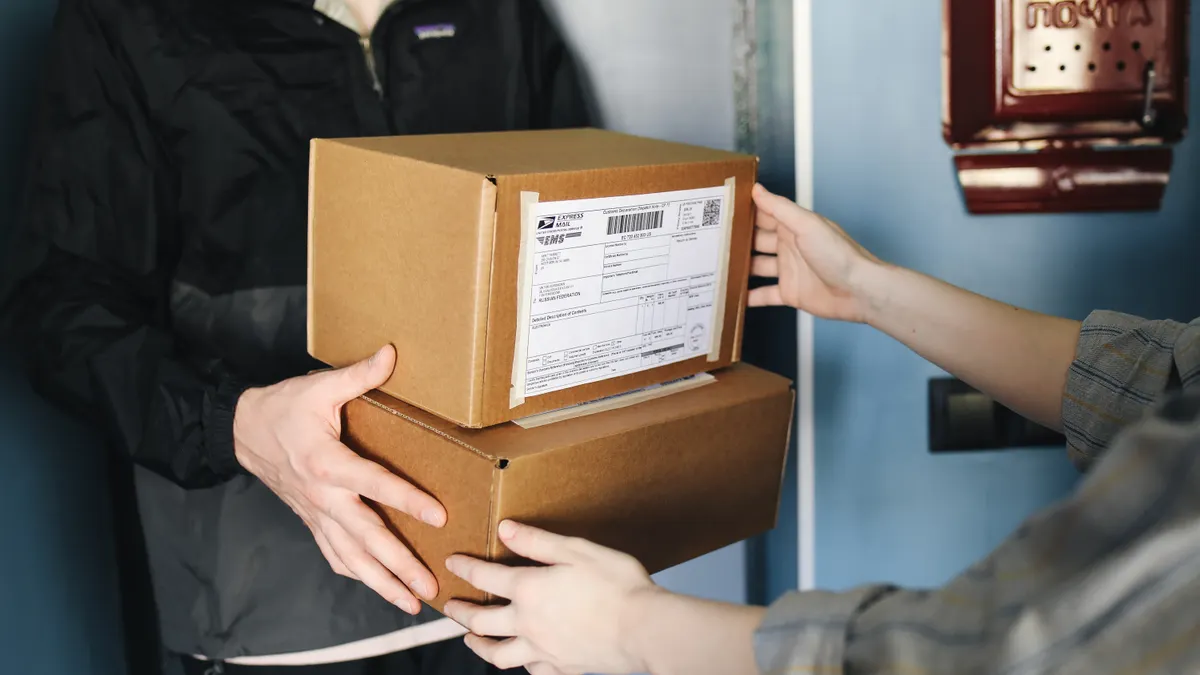
Compare shipping options by looking at transit time, service level, carrier handling, delivery window, and what happens if something goes wrong. The label on the checkout page is not enough.
A useful comparison starts with the service standard. Ground, two-day, overnight, freight curbside, threshold delivery, and white-glove service are not interchangeable. A smaller parcel may move through a standard parcel network, while a refrigerator or desk may be limited to freight or scheduled delivery. Different services create different failure points.
The questions that matter are straightforward:
- What is the promised transit time, and is it business days or calendar days?
- Is signature required?
- Does the carrier deliver to the door, the curb, the threshold, or the room of choice?
- Who handles damage claims if the box arrives crushed?
- What is the return path if the item is wrong or defective?
A faster service can still be the worse deal if it has narrower delivery windows, higher miss rates, or no room-level placement. A slower service can be better if it is more predictable and less likely to arrive when nobody is there to receive it.
The biggest trap is assuming “delivery” ends at the doorstep. For bulky items, the real delivery decision includes stairs, elevators, assembly, disposal of packaging, and whether the driver is allowed to carry the item inside. A curbside appliance drop may look cheaper than white-glove service until you account for the labor and vehicle needed to move it yourself.
The best comparison uses total effort, not just shipping line items. If one option saves $25 but adds two hours of labor, a second trip, or the risk of a failed handoff, the savings may vanish quickly.
The honest side-by-side: direct purchase vs marketplace seller
Direct purchase wins when you care most about support, consistent packaging, and a cleaner returns path. Marketplace sellers win when stock is scarce, model variants matter, or the marketplace gives access to more choice than the brand store.
| Criteria | Direct purchase | Marketplace seller | Winner for [condition] |
|---|---|---|---|
| Support path | Usually clearer warranty and returns process | Can vary by seller and marketplace rules | Direct purchase for warranty-sensitive items |
| Price variability | Often steadier, sometimes less discounting | More volatile, with more frequent promos | Marketplace for shoppers comparing current offers |
| Stock breadth | Limited to the maker’s catalog | Broader mix of colors, bundles, and revisions | Marketplace when variants matter |
| Seller accountability | One accountable brand in most cases | Depends on seller quality and fulfillment model | Direct purchase for low-risk buying |
| Packaging consistency | Usually more standardized | Can vary across third-party sellers | Direct purchase for fragile goods |
| Shipping speed options | May be narrower | Often multiple fulfillment choices | Marketplace for urgent buys |
| Returns friction | Often cleaner if bought from the brand | Can be easy or messy depending on seller | Direct purchase for high-return-risk items |
| Authenticity confidence | Usually higher | Requires more attention to seller identity | Direct purchase for branded, counterfeit-sensitive goods |
| Best use case | Standardized purchase with known support needs | Comparison shopping across sellers and bundles | Depends on the buyer’s priority |
The table is blunt on purpose: direct purchase usually wins on predictability, while marketplace buying usually wins on selection and price competition. That does not mean one is universally better. It means each has a different failure mode.
Direct purchase is the safer bet for appliances, electronics, and branded parts when the buyer wants a single point of contact. The drawback is that the brand store may not offer the best current deal or the fastest ship date. Marketplace buying is better when the same item appears from multiple sellers, but the cost is more variance in seller quality and fulfillment reliability.
A buyer should be suspicious of marketplace listings that look identical but come from different sellers with different return rules. A low price is not useful if the seller ships the wrong revision or makes the return process slow enough to erase the savings.
When direct purchase wins, and when it does not
Direct purchase wins for items where warranty clarity, parts compatibility, and clean support matter more than a small discount. That is especially true for appliances, power tools, electronics, and anything that may need replacement parts or service documentation later.
The biggest strength of direct buying is accountability. The brand store is usually better positioned to confirm model numbers, accessory compatibility, and the difference between a current revision and an older one. That matters because many buyer complaints come from model confusion, not product failure. A one-letter suffix or a regional revision can change plugs, manuals, or included accessories.
Direct purchase also tends to simplify claims. If a unit arrives damaged, the buyer is not trying to sort out whether the problem belongs to the seller, the marketplace, or the carrier. That matters for expensive items where a return label, pickup, or replacement shipment can take days.
The weakness is obvious: direct stores often lose on flexibility. They may not have the widest selection, and they may not offer the cheapest current bundle. They can also be slower to discount older stock. If the buyer is shopping for the lowest visible price and can tolerate more complexity, direct purchase is not always the best play.
Direct buying is not for someone who needs same-day local pickup, wants to compare multiple third-party sellers at once, or is comfortable handling a messy returns chain in exchange for a better deal. It is also a poor fit when the item is commodity-like and the only thing that matters is current price.
A simple rule: choose direct purchase when the cost of confusion is higher than the savings from shopping around. For a $20 item, that may be too cautious. For a $500 or $2,000 item, it is often the right stance.
When marketplace buying wins, and when it does not
Marketplace buying wins when inventory, speed, or bundle options are the real constraint. If the product is a standard item with multiple sellers, the marketplace can surface a faster ship date or a more useful bundle than the brand store.
Its main strength is choice. A marketplace can show the same product from several sellers, often with different shipping promises, return windows, and fulfillment methods. That helps when the buyer is balancing a deadline against a price ceiling. It can also help for replacement parts or discontinued variants that no longer appear on the maker’s own site.
Marketplace buying is also useful when the buyer wants to compare seller reputation and fulfillment details without visiting multiple sites. That is a real time saver for routine purchases. The best marketplace listings make it easy to see whether the seller is the brand itself, a trusted distributor, or an unknown third party.
The downside is consistency. Two identical-looking listings can have very different service outcomes. One may ship from a warehouse with reliable packing and clear return labels. Another may be a drop-shipper with slower responses and a less predictable claims process. The buyer is not just choosing a product; the buyer is choosing a seller.
Marketplace buying is not the right call for counterfeit-sensitive goods, specialty equipment, or any item where warranty support depends on authorized sale channels. It is also weaker when the buyer does not have time to verify seller identity, return rules, or fulfillment method.
A good rule is this: use the marketplace when you are confident enough to judge the seller, not just the listing. If the seller details are unclear, the real savings may be fictional.
What delivery method should I choose for fragile or bulky items?
Fragile or bulky items should usually be delivered by the method that reduces handling, not the method that only reduces the quote. For a glass table, large monitor, appliance, or assembled furniture piece, the best option is often the one with the fewest transfers and the clearest damage policy.
This is where “delivery” stops being a simple shipping choice and becomes a handling decision. More handoffs mean more risk. The parcel network, linehaul transfer, local depot, and final-mile driver can each add another chance for dents, punctures, or misrouting. Bulky items also raise the stakes for building access, stairs, elevators, and the return trip if nobody can accept the delivery.
For these items, the right question is not “How fast?” It is “How much handling will this item survive?” A mattress or sofa can tolerate slower transit but may need scheduled delivery and room placement. A delicate electronics package may need stronger packaging and a signature option. A refrigerator may need threshold or room-of-choice delivery because curbside drop-off shifts all labor to the buyer.
There is a trade-off here: better handling usually costs more and may require more scheduling. That inconvenience is often worth it. The cost of a damaged bulky item is not just replacement price; it is time, disposal, reordering, and missed installation dates.
The wrong choice is often the cheapest curbside option for a big item when the buyer has no easy way to move it. If the item weighs more than one person can safely handle, the “savings” can disappear into labor, rental equipment, or injury risk. For an appliance or furniture delivery, better service is often the cheaper total decision even when the shipping line looks worse.
When should the choice flip completely?
The verdict flips when the purchase stops being a normal consumer buy and starts carrying operational risk. In those cases, a cheaper or faster option can be the wrong decision even if it looks efficient on paper.
1) The item is needed for work tomorrow
If a missed delivery stops revenue, choose certainty over savings. A contractor waiting on a job-critical part, a clinic waiting on supplies, or a retailer waiting on stock cannot treat delivery as a casual variable. In that case, paying for local pickup, same-day courier, or the most reliable scheduled service is justified.
2) The item is fragile and hard to replace
If damage would force a full reorder, do not chase the lowest shipping quote. A fragile item with poor packaging or multiple handoffs is a bad bet. The better move is to choose the seller or delivery method that minimizes handling and has a clear claims process.
3) The item has compatibility risk
If a model number, connector type, or revision suffix matters, the safest choice is the source that can document exactly what is being sold. This is where direct purchase often beats marketplace convenience. A small mismatch can make a “deal” unusable.
4) The buyer cannot receive the item in person
If nobody is available to sign, inspect, or move the package, the best delivery method may be the one that allows pickup or scheduled arrival. The cheapest shipping option can become the worst when it leads to a missed delivery, a return-to-sender fee, or a damaged drop-off.
These exceptions matter because they change the category of the decision. Once delay, damage, or compatibility can cause real downstream cost, the lowest sticker price loses authority.
The verdict: how to make the call
Choose direct purchase if the item is expensive, warranty-sensitive, or likely to need support later. Choose marketplace buying if the product is standardized, you need more seller choice, or you are comparing current shipping dates and bundles. Neither if the item is mission-critical, fragile, or hard to receive properly and the seller cannot offer a delivery method that matches the risk.
That is the cleanest rule. If the buyer needs a single accountable source, direct purchase is the safer path. If the buyer needs speed, choice, or a better deal on a known commodity, marketplace buying usually wins. If the shipment is tied to an immovable deadline or a high damage cost, the decision should move away from price entirely and toward certainty.
The mistake to avoid is pretending these are equivalent choices. They are not. One path tends to reduce confusion; the other tends to expand it in exchange for more options. The correct answer depends on which problem is actually expensive.
What should I ask before clicking buy?
The first question is whether the item matters more as a product or as a delivery event. If the item can arrive a few days late without consequence, price matters more. If timing or condition matters, delivery quality takes priority.
A second question is whether the seller can handle the whole problem if something goes wrong. If the answer is unclear, the buyer should slow down. A clean returns path and an understandable warranty are worth more than a slightly lower checkout total, especially on a $200-plus purchase.
A third question is whether the item is easy to replace. If it is not, the buyer should favor the source with better accountability, better packaging, and a clearer support process. That is usually the decision that looks less exciting and works better later.
What’s the most common mistake people make?
The most common mistake is choosing the cheapest shipping option and then treating delivery failure as bad luck. It is not bad luck if the item was fragile, the window was inconvenient, or the seller’s return policy was weak. The real mistake happened at checkout.
A close second is ignoring who is actually shipping the order. A well-known storefront does not guarantee a careful seller, and a low-cost listing does not automatically mean a poor outcome. The seller, the carrier, and the delivery method all affect the result.
How do I avoid overpaying without making the wrong choice?
The safest way to avoid overpaying is to compare the full landed cost, not just the product price. That means adding shipping, return friction, installation if needed, and the cost of delay. A low checkout number can still be the expensive choice if it creates a problem later.
The second safeguard is to match the delivery method to the item. Small, durable goods can usually tolerate standard shipping. Fragile, bulky, or deadline-sensitive items need more careful handling. When the stakes rise, the cheaper option should have to prove itself, not the other way around.
Is there a simple rule I can use every time?
Yes: buy the option that makes the fewest things go wrong. If that means paying more for direct support, choose direct purchase. If that means using a marketplace with better stock or faster shipping, choose the marketplace. If the delivery is time-critical or fragile, choose the method with the clearest handling and claims path, even if it is not the cheapest line item.
That rule is simple enough to use in real life and strong enough to avoid the common traps.
Drafted with AI; not yet reviewed by a person.
Leave a Reply